
How to price a custom job: add up the direct costs (materials, labour, outsourced services, transport), add the job's share of your overheads and a risk reserve, then apply your target margin. The basic formula is price = full cost ÷ (1 − target margin). Travel, re-work, design time and changes requested after signing are easy to forget; CRM and ERP software then helps you compare the price with real costs.
This guide is for furniture workshops, window and gate companies, metal fabricators and anyone else who does one-off work. It shows what goes into the price, how to calculate an hourly overhead rate, the difference between margin and markup, and how to handle deposits, changes and re-work.
In short
- Full cost = materials + labour + outsourced services + transport + overhead + risk reserve.
- Margin is measured against the price, markup against the cost: a 25% markup is only a 20% margin.
- Overhead is spread over productive working hours and included in the price of every job.
- We recommend re-pricing any change after signing and confirming it in writing before the work starts.
- After handover, compare the actual cost with the estimate and correct your next prices.
How to price a custom job: what goes into the price
- Materials: the quantity from the design plus cutting waste and small hardware, at the supplier's current price.
- Labour: estimated hours times the full cost of an hour of work, meaning wages plus social contributions and other employer costs.
- Outsourced services: cutting and edge banding, painting, glass, CNC machining, a crane or other services you buy in.
- Measuring, design and travel: time spent at the client's site and on the design, plus fuel.
- Overhead: rent, utilities, office salaries, tools, software, accounting.
- Commissions, if you pay a designer or manager a percentage of the order value. Because they are a share of the price, put them straight into the formula: price = full cost ÷ (1 − margin − commission).
- Risk reserve: for new types of work, demanding materials or undecided clients.
- Margin: what is left for the business, for growth and for quieter months.
How to calculate overhead per hour
Overhead is the part of your costs that does not belong to any single job but without which you cannot work. The simplest fair way to share it is per productive hour: overhead rate = monthly overheads ÷ productive hours per month.
Productive hours are not 8 hours times working days times people. Subtract breaks, holidays, time that belongs to no job (cleaning, maintenance, trips to suppliers) and days without orders. Hypothetical example: three people with 125 productive hours a month each work 375 hours in total; with overheads of 30,000 MDL a month, the overhead rate is 30,000 ÷ 375 = 80 MDL per hour.
A simpler option is a percentage of direct cost. The drawback: a job with expensive materials and little work gets too much overhead, and a job with lots of work and cheap materials gets too little. Whichever method you choose, it is best applied the same way to every job.
Margin vs markup: the formulas
Margin and markup start from the same difference, price minus cost, but compare it with different things:
- Markup (%) = (price − cost) ÷ cost × 100
- Margin (%) = (price − cost) ÷ price × 100
- Price from markup = cost × (1 + markup)
- Price from margin = cost ÷ (1 − margin)
- Conversion: margin = markup ÷ (1 + markup); markup = margin ÷ (1 − margin)
Example: with a cost of 10,000 MDL, a 25% markup gives a price of 12,500 MDL, which is a 20% margin. If you want a 25% margin, the price must be 10,000 ÷ 0.75 = 13,333 MDL, which is a 33.3% markup.
Margin is calculated from the price, markup from the cost. Mix them up and you lose a few percent on every job without noticing.
Rule of thumb
Worked example: pricing custom furniture in lei
The example is hypothetical, with round numbers and without VAT, for a custom kitchen in Moldova. It does not reflect market prices; use your own costs.
- Materials, including cutting waste and hardware: 17,500 MDL.
- Outsourced services (cutting and edge banding, painting the fronts): 3,500 MDL.
- Labour (design, workshop and installation): 50 hours × 120 MDL = 6,000 MDL.
- Transport and travel: 1,000 MDL.
- Overhead: 50 hours × 80 MDL = 4,000 MDL.
- Risk reserve, 5% of the subtotal above (32,000 MDL): 1,600 MDL.
The full cost is 33,600 MDL. For a 25% margin, the price is 33,600 ÷ 0.75 = 44,800 MDL, rounded to 45,000 MDL before VAT. At 45,000 MDL the estimated profit is 11,400 MDL, a margin of about 25%.
If the workshop had applied a 25% markup by mistake instead of a 25% margin, the price would have been 33,600 × 1.25 = 42,000 MDL: 2,800 MDL less, with a real margin of 20%.
A quick sanity check: work out the price per running metre or per square metre and compare it with the same figure for your previous jobs. If it comes out much lower, look for what you forgot; if it is much higher, check the hours and the reserve.
How to handle deposits, changes and re-work
Deposits
A deposit is not extra profit but part of the price paid earlier. Its job is to cover materials and outsourced services, so that you do not finance the work yourself. Each company sets its own percentage; in the example, a 60% deposit is 27,000 MDL, enough for materials and services (21,000 MDL). We explained how to track instalments and balances in the guide to customer deposits and balances.
Changes after signing
A change requested after signing is priced like the job itself: materials, hours, overhead and margin, plus anything already lost, such as cut panels or hours worked. We recommend confirming the new price and deadline in writing before you start the change. Ten small changes accepted out of politeness can eat the whole margin.
Re-work
Re-work caused by the workshop is not paid by the client, but it still costs money. It is worth recording it as a separate expense on the order to see the real margin. In the example, 2,000 MDL of re-work cuts the profit to 9,400 MDL and the margin to about 21%. After a few months, your average re-work cost tells you how big the risk reserve is worth making.
Example checklist before you send the price
- Measurements are confirmed on site, not estimated over the phone.
- Material prices are current, from a recent supplier quote.
- Cutting waste, small hardware and transport are included.
- Hours include design, installation and travel.
- Overhead is calculated the same way as on other jobs, per hour or as a percentage.
- There is a risk reserve for new or unclear work.
- The margin is calculated from the price, not from the cost.
- It is clear whether the price includes VAT and how long it is valid.
- The payment instalments are agreed in writing.
- What is not included, such as removing old furniture, is stated explicitly.
How Zafirok helps: CRM and ERP software for your orders
Zafirok has no module for client quotes and does not calculate the price of a custom job: you do the calculation in your own sheet, for example in Excel. The app helps afterwards, by showing whether the job turns out as you calculated:
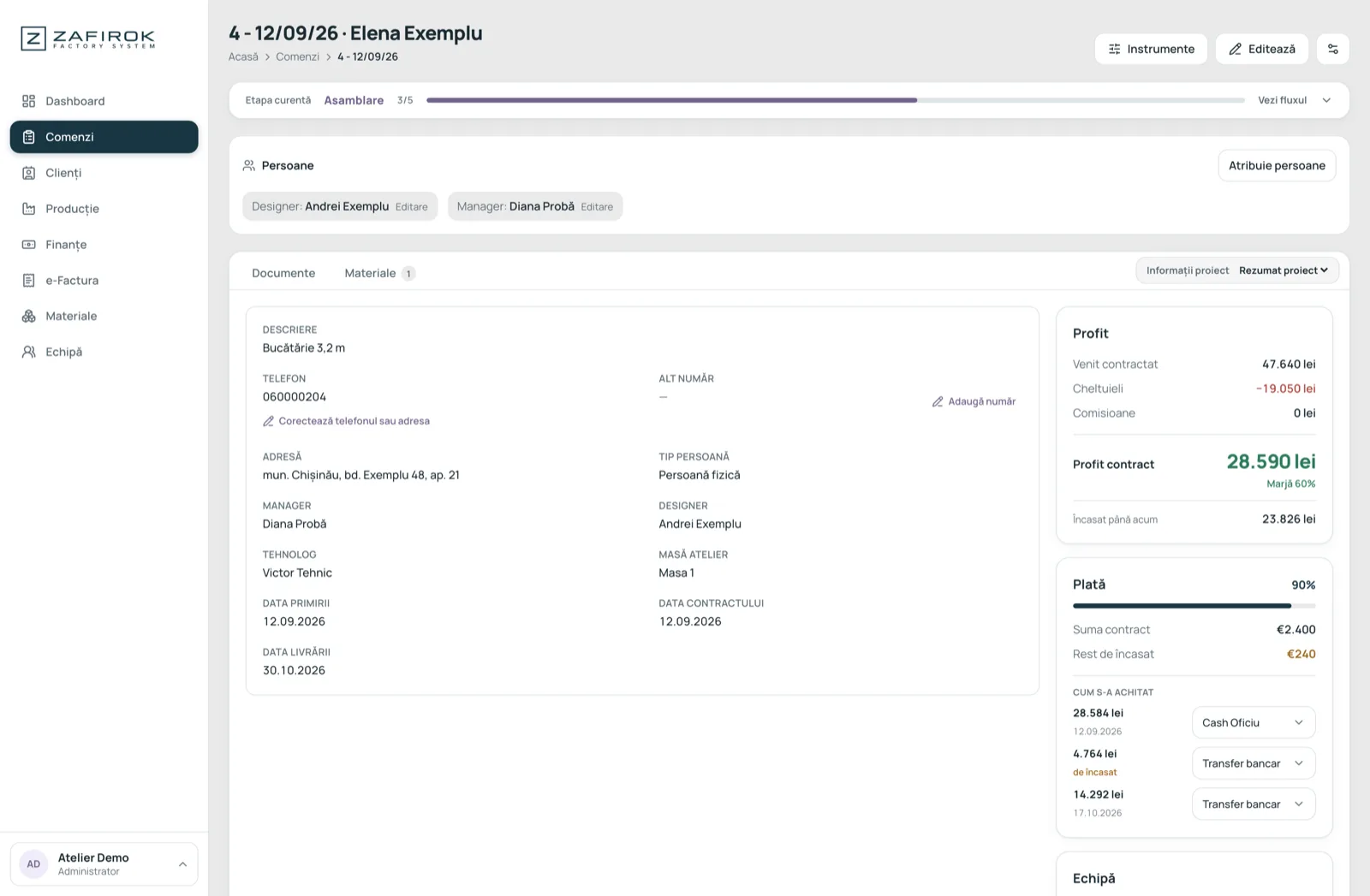
- The order value is recorded on the order at signing. In the production configurations (furniture, windows, gates and others) the field is called “Contract value” (“Valoare contract”) and is entered in euros, with the lei equivalent shown for companies in Moldova.
- Job expenses (materials, outsourced services, transport) are recorded in Finance → Transactions, with a category and linked to the order, and they appear in the order's Expenses tab. Categories, for example a separate one for re-work, are edited in Settings → Commercial → Lists.
- The order's side card shows the profit (order value minus the expenses and commissions recorded on the order) and the margin, measured against the order value. Your overhead and your team's labour are not included unless you record them as expenses on the order. In the production configurations, however, if you enter measurements in the “Commissions & m²” tab, the technologist's and assembler's pay per m² is deducted automatically under “Commissions”. So compare the card's margin with a target calculated on the same costs, with the value and the expenses entered on the same basis, both with VAT or both without. In the example above, if only the 22,000 MDL of materials, outsourced services and transport are recorded on the order, the card shows a margin of about 51%, not 25%.
- Payments are kept on the order, with “Left to collect” and the percentage paid; the production configurations also have a “60–30–10 payment plan”, the default split.
- Your calculation sheet (Excel or PDF) and the design approved by the client can be attached in the order's Documents tab, with files up to 25 MB, so the team knows what the price includes.
- In the furniture configuration, designer and manager commissions (a percentage of the contract value) are created automatically when the order enters the technical design stage (“Technolog”) and are included in the profit calculation.
The stages, the 60–30–10 plan and the payment checks are a default model: an order cannot leave “Designer” below 60% paid or “Instalare” below 100%, and renaming those stages switches the checks off. Each company sets up its own stages, categories and roles; if you prefer, the Zafirok team can configure it for you: write to us via the contact page or create an account.
One exception: for carpet cleaners, the price is calculated automatically from square metres and the rates set in Settings → Commercial → Rates. For running a furniture workshop, see also the Custom furniture page, and for tracking money per order, the Finance module.
Frequently asked questions
What margin is normal for a custom job?
There is no percentage that fits every workshop: it depends on your overheads, your risk and your market. First calculate the full cost, below which you lose money, then set the margin from there and from what your clients accept.
Should I calculate prices with or without VAT?
It depends on your company's tax position, for example whether it is registered for VAT, so agree the rule with your accountant. For the calculation, one simple principle applies: any supplier VAT your company cannot reclaim stays part of the job's cost. The worked example in this guide is without VAT.
How long should a price be valid?
You can put a validity period in the quote, for example 7 or 14 days, and state that material prices are confirmed when the deposit is paid. That way you are not tied to an old price when the supplier changes theirs.
Can Zafirok produce the quote for the client?
No, Zafirok has no quotes module. You calculate in your own sheet, then track each order’s value, payments, expenses, profit and margin in the app.
How do I know if I am underpricing my jobs?
After handover, compare actual costs with the same items in your estimate: the expenses recorded on the order and the hours actually worked, from your own timesheets. If the real margin is consistently below the planned one, raise the risk reserve or correct your hour estimates.
Create an account and see the profit on every order